For Lincoln, NIH Provides the Best Chance at Living His Best Life
Five-year-old with Loeys Dietz Syndrome is contributing to groundbreaking research into a new disorder
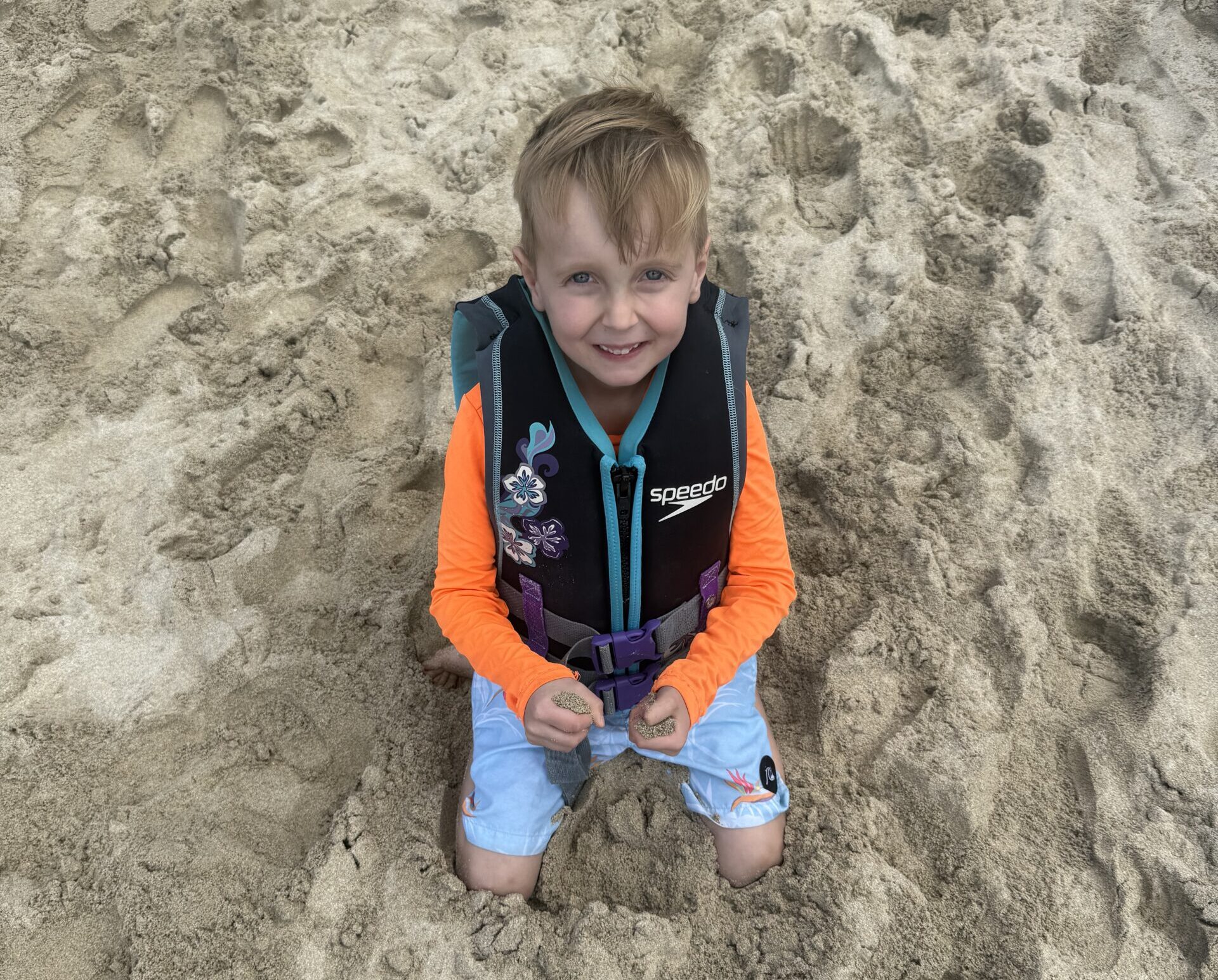
“Let me show you what I can do!”
This expression is a favorite of five-year-olds all over the world, and Lincoln, the youngest of three boys from Glendale, Arizona is no exception.
What he does when he says it, though, is unusual. Lincoln has Loeys Dietz Syndrome (LDS), a connective tissue disorder that impacts the entire body. This leaves him susceptible to aneurysms and ruptures of his blood vessels, and it has also contributed to an extreme hypermobility, or double-jointedness.
At his age, Lincoln’s hypermobility is almost a special talent. His mother Julie jokes that this has given him “a lot of bar tricks for the future!” But she tells him, “just because you can do it, doesn’t mean you should,” as she points out what no five-year-old wants to hear, since his talent for twists and bends can lead to significant joint issues down the road.
Lincoln was born with a cleft palate, which was repaired when he was still an infant. As doctors treated him, they ran standard genetic testing, none of which raised any flags. However his parents, Julie and Drew, began to notice concerning issues with their youngest boy.
“He had two wandering eyes when he was born,” Julie explained. “And his skin was translucent – Lincoln has the softest skin in the world.” He had also already developed some signs of his hypermobility, including a foot that naturally angled in towards his other leg.
So Julie asked the geneticist, who had run the initial testing, to run tests comparing her genome as well as her husband’s, to Lincoln’s. That test revealed a genetic mutation that would lead to the diagnosis of LDS. “You essentially get half of your genes from mom and half from dad,” Julie described. “So, everything should match up to either mom or dad. And this one area didn’t, and our geneticist, who has been in practice for around 30 years, said it was the first Loeys Dietz syndrome that she had diagnosed. It’s only been a known syndrome for about 20 years.”
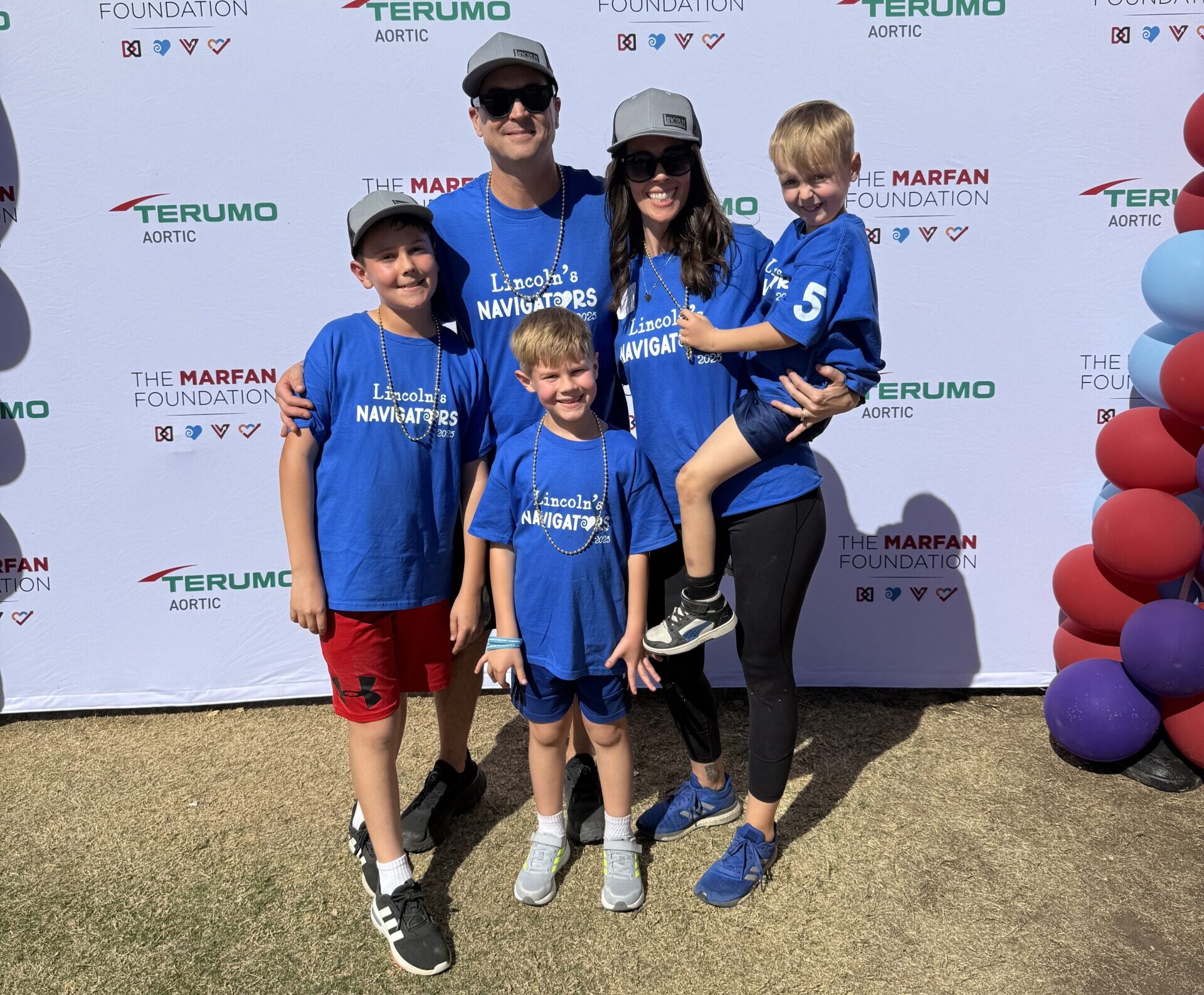
Lincoln and his family (L-R: his brother Vincent, his father Drew, his brother Dominic, his mother Julie, and Lincoln)
With LDS still being a relatively new discovery, doctors and researchers are still gathering data to determine what causes it and how it can be treated. For one thing, although it is a genetic disorder, LDS is almost always the result of a de novo mutation. This meant that although Julie and Drew were not carriers of LDS, the mutation in Lincoln’s genetic makeup caused his LDS and would leave his own children susceptible to the disorder, should he have any later in life.
Although the hypermobility has led to more amusement than discomfort for the five-year-old Lincoln, he does deal with weaker hands and knees and a foot that tends to point inward. Still, the primary problem because of his LDS has been aortic issues. As Julie describes it, his blood vessels “look like wet spaghetti noodles that have been thrown against the wall.” Additionally, his LDS has led to dental issues with weakened enamel. Also, due to his propensity for arterial aneurysms and ruptures it can make his tree nut allergies more difficult to treat if he is exposed. For him, the EpiPen that would typically take care of any anaphylactic reaction, might constrict his blood vessels to a point that ruptures and aneurysms could become more of an issue.
Once their son was diagnosed at 12 months old, Julie and Drew were quickly connected with a team at both Johns Hopkins Hospital in Baltimore and the National Institute of Allergy and Infectious Diseases at the National Institutes of Health in Bethesda. They were all in.
“We believe in research,” Julie said. “We think that if we’re not willing to help with research, why should someone be willing to help us?”
Lincoln began seeing Dr. Hal Dietz – who first observed and described the syndrome alone with Dr. Bart Loeys in 2005 – at Johns Hopkins when he was just 18 months old. Shortly after, upon his first visit to the NIH, he also made regular visits to Dr. Pamela Guerrerio at NIAID, as well as several other clinicians.
“Lincoln presented pretty early,” Dr. Guerrerio explained when recalling Lincoln’s early visits. “A lot of people may not present with LDS until they have an aortic dissection* and a very severe outcome like that brings them in for medical attention. But Julie is so astute. She is so knowledgeable and she seeks out information. She’s such a good advocate for him and that makes them such good research participants.”
Dr. Guerrerio coordinates Lincoln’s care, which is split between NIH and Johns Hopkins, where she earned her Ph.D. in Human Genetics. Because of the need to coordinate with genetics/cardiology, gastroenterology, and cardiac surgery who are located at Hopkins in Baltimore, many LDS patients under Dr. Guerrerio’s care at NIH—ranging in age from two to patients in their 70s—also see experts at Hopkins as part of their care.
For their first few visits to NIH, Lincoln and his mother stayed at a nearby hotel. On their most recent visit, they were offered a spot at The Children’s Inn. At first, Julie was hesitant. They had developed a routine on visits to Bethesda, going to a grocery store near their hotel to get Lincoln olive and pickles or going to get pizza and ice cream after days of appointments and tests. But then she visited The Inn’s website.
“As I looked everything up,” she remembered, “I realized ‘oh he’s going to be in heaven.’ He gets to open a mailbox for a Thoughtful Treasure every morning? He’s so in! But more than that, it was just so nice being so close to campus, and wonderful to have a kitchen.”
Lincoln’s visit to The Inn came as the holidays were approaching, and he was missing his brothers. Though he loved the play areas, he quickly connected with a 13-year-old named Tiago. At first, Lincoln watched the older boy play video games as he would have watched his own brothers at home. Before long, the two were attached to each other, the eight years separating their ages melting away as they chatted and played new games.
Julie loved the holiday spirit that was visible throughout The Inn during their visit. Lincoln was missing a few days of their home Elf on a Shelf, Walter, and was thrilled to see an elf in different locations each day as they stayed at The Inn. He also was mesmerized by The Inn’s annual Santa Ride as the caravan of MCPD motorcycle officers pulled into the parking lot just moments after he had returned from his daily appointments.
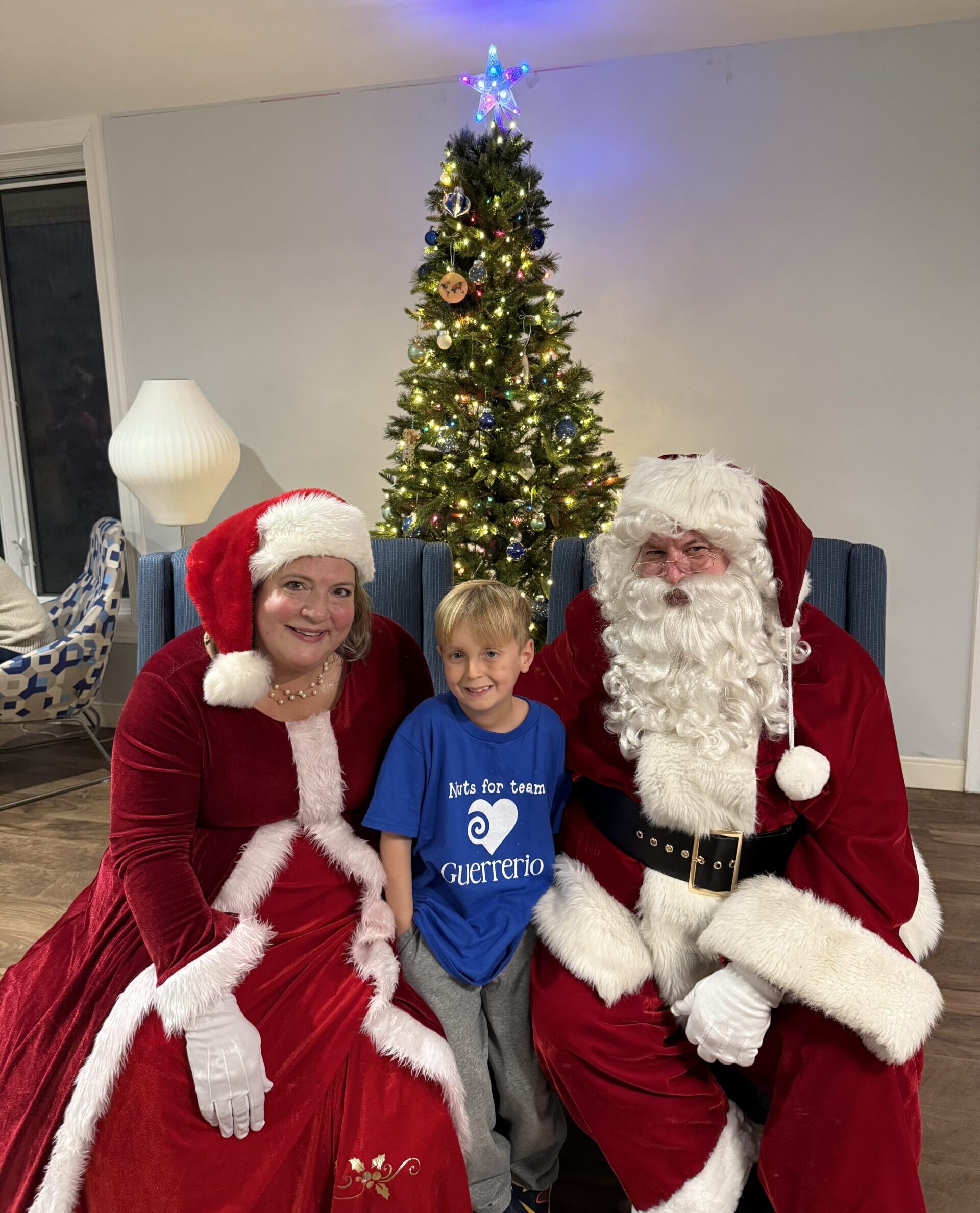
Lincoln met Santa and Mrs. Claus at The Inn’s annual Santa Ride event
“This was our first experience at The Inn and it was just magnificent,” Julie gushed. Although she was aware that half the building was closed for the expansion and renovation of The Inn of Tomorrow, it was still an incredible environment for her and Lincoln providing the “Place Like Home” they had never imagined possible. “If that’s only half of what there is at The Inn,” she exclaimed, “we can’t wait for next time!”
She also pointed out how important having a place like The Inn was not just for Lincoln, but for parents like her.
“The Inn does so many amazing things for the kids, but you don’t realize how important it is for the parents too,” she explained. “Beyond having the amenities of home, there are other parents with kids that have medical issues, so there is a built-in camaraderie. You instantly know that they understand the joy and sorrow that you feel for your child every day, and there is something very comforting about that. There is no judgment, just compassion.”
Dr. Guerrerio knows how important The Inn is to her ability to treat Lincoln and so many others like him.
“The Inn is one of the jewels of the NIH,” she exclaimed. “Without question, it is such a fantastic place. Our patients love to be there. I think it’s one of the reasons we are able to recruit young kids to come to the NIH for research studies that they might not necessarily benefit from right away, because The Inn is such a fun place to be, and we are so grateful for that.”
Back home in Arizona, Lincoln is excelling in the bright child kindergarten program in which he is enrolled. “He’s a smart little whip,” Julie smiled. “He’s learning Spanish, so he runs around the house speaking his minimal Spanish and smiling.” Lincoln also loves singing lessons and Cub Scouts and has found a way to join his family in their love of sports and physical activity.
“We’re a big soccer family,” Julie said. “My husband played semi-pro and my older boys play, but Lincoln can’t do any contact sports. He likes kicking the ball around in the backyard, but he can’t have balls flying at his chest or his head, or especially people flying at him! So he has taken some golf lessons. We figure that’s something we can do as a family.”
Lincoln looks and acts much as a typical five-year-old would. As grateful as Julie is for that – she describes their situation as “the best of the worst” – she knows that the lack of outward symptoms presents its own challenges.
“It makes it harder because you have to helicopter parent,” she admitted. “He wants to jump off things. He wants to climb. He wants to make noise. And he’s hypermobile so he’s less coordinated and definitely clumsier. Which can lead to easier injuries.”
For now, Julie and Drew have embraced their role as parents to a child with LDS. Lincoln’s brothers, Vincent (11) and Dominic (8) are also great with their younger brother.
They have also embraced their role in helping further medical research and hopefully improving the quality of Lincoln’s life as he ages. Most of his treatment at NIH is physical and occupational therapy, not medicinal. His doctors keep an eye on his respiratory function and blood vessels via regular MRIs, and most importantly keep his parents well informed about what they are seeing and how their options develop.
“Anytime we see a doctor, I ask if they know what LDS is,” Julie said. “And a lot of times they’ve never heard it, or they say they looked it up before they walked into the room for his visit because they read about it in Lincoln’s history. That can be disheartening, and yet it’s understandable.”
I don’t expect someone to know everything about anything,” she continued. “But I feel like at NIH, we get to go and see the people that give us the best chance of giving him the best life he can have. I’ve researched so much about [LDS], but every time I go, they give me information. I fall in love with all of these people working there because they can give me answers about my child.”
For now, Lincoln is content to be able to twist his joints into pretzels. But keep an eye on him, and on the research he and his family are contributing to at the NIH. Together, there’s no telling what he will one day be able to do.
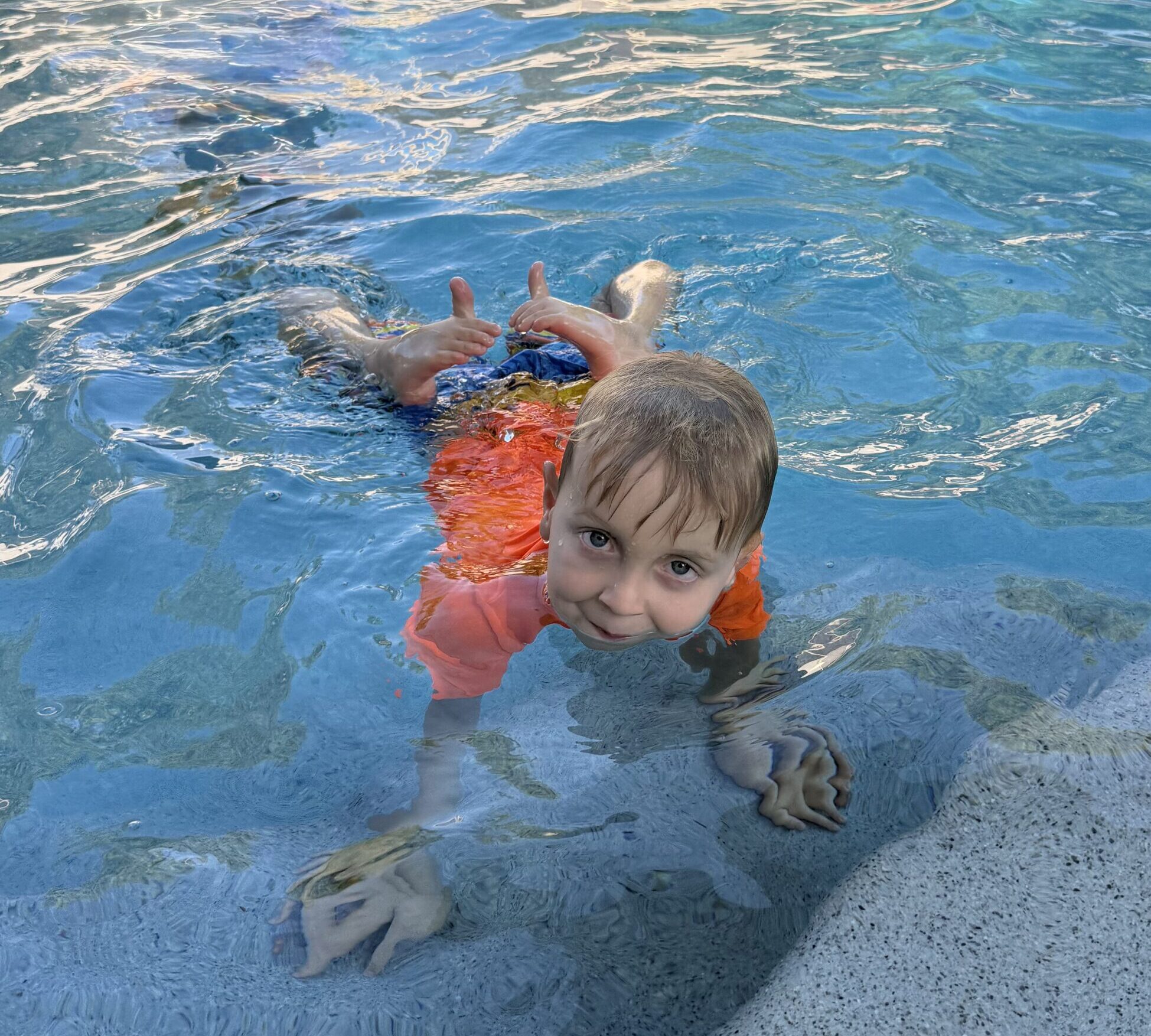
Lincoln shows off his hypermobility in the pool
* An aortic dissection is an often-deadly medical emergency in which a tear in the aorta leads to significant internal bleeding.